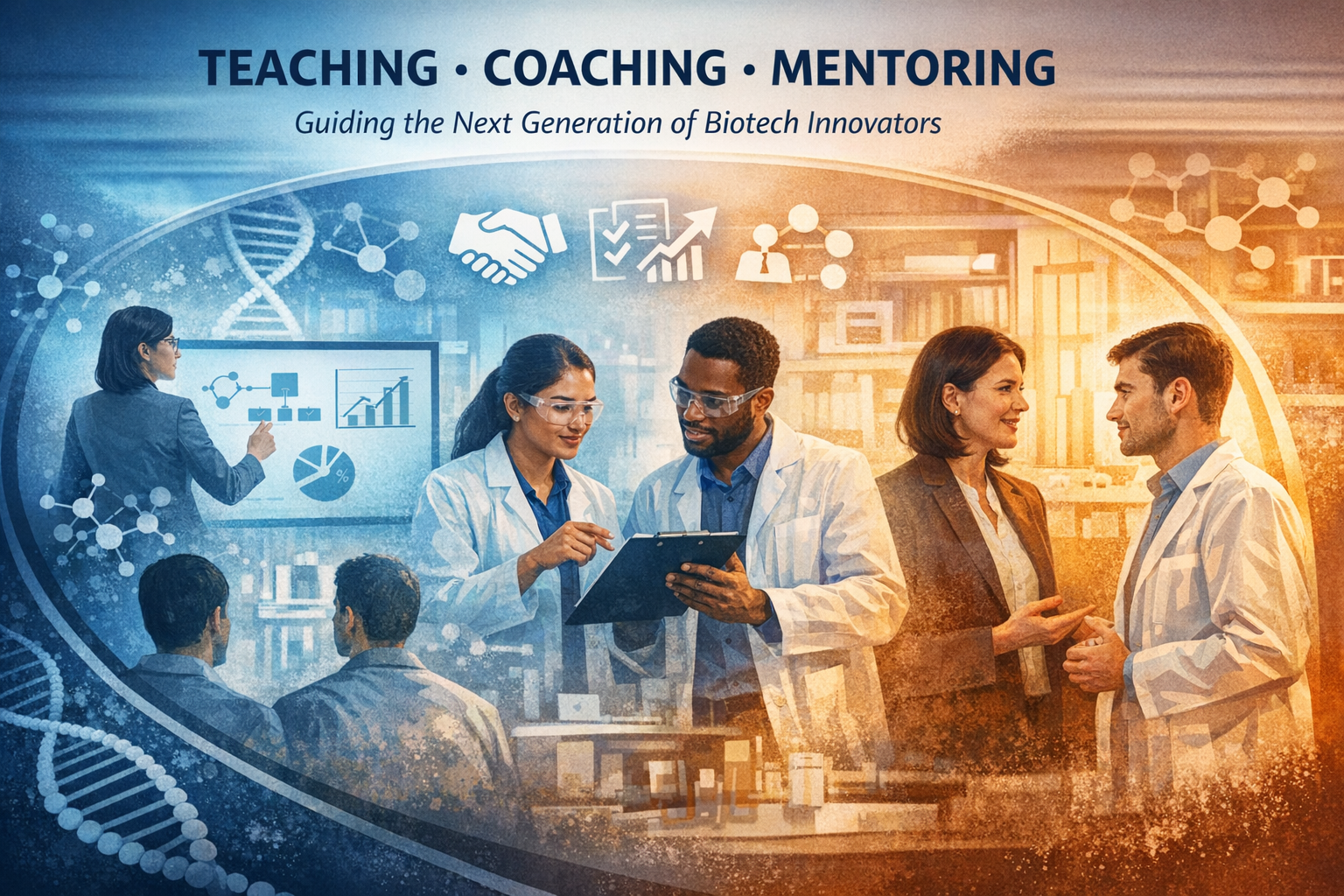
At BioVertex Consulting, a growing part of my work focuses on teaching, coaching, and mentoring scientists and early venture teams as they navigate this transition. Earlier this year, I had the opportunity to teach an academic biotech audience on what it takes to move ideas beyond the lab. While the sessions covered practical aspects of execution, what stayed with me most were the conversations afterward.
The questions were thoughtful and revealing:
How can I trust an Advisory Network with my proprietary data?
What does effective stakeholder management with remote external vendors/CROs look like?
Where can I find relevant consultants for my project?
These are not questions about science. They are questions about context, confidence, and direction, and they highlight a gap that many academic and early-stage biotech teams face.
Teaching What Isn't Explicitly Taught
Academic environments do an excellent job of developing deep scientific expertise. What is often missing is exposure to how decisions are made outside the university — by investors, industry partners, and regulators.
When I teach academic audiences, the goal is not to push commercialization for its own sake. It is to demystify the ecosystem:
- How development pathways actually unfold
- How risk is evaluated at different stages
- How scientific choices influence downstream options
Teaching provides context. It helps researchers understand where their work fits and what choices lie ahead, so they can make informed decisions about translation on their own terms.
Coaching Teams Through Early Uncertainty
I also coach early-stage venture teams, many of them academic spinouts, who are navigating ambiguity for the first time. These teams are often strong scientifically but face new challenges: prioritization, alignment, and decision-making under uncertainty.
Coaching in this setting is about building decision-making confidence. Together, we focus on:
- Clarifying objectives
- Sequencing work realistically
- Aligning scientific goals with funding and partnership expectations
Having a neutral, experienced sounding board can significantly change how teams approach both strategy and execution.
Mentoring People, Not Just Projects
Perhaps the most personal aspect of this work is mentoring individuals as they redefine their professional identity. Moving from academic scientist to venture leader, or even exploring that possibility, can be uncomfortable. Mentorship provides space to ask difficult questions, build confidence, and explore paths forward without pressure. Not everyone needs to become a founder, but everyone benefits from clarity about what comes next.
The Gap Between Scientific Excellence and Translational Readiness
Academic training produces world-class scientists. What it rarely prepares them for is the full reality of commercial drug development: how investors evaluate risk at each stage of a program, how regulatory bodies assess data packages and what evidence thresholds actually look like in practice, and how manufacturing constraints shape development decisions long before a molecule ever reaches a patient. These are not peripheral considerations. They sit at the centre of every major decision a biotech team will make, and scientists who encounter them for the first time mid-program often find themselves making choices without the frameworks to evaluate the tradeoffs clearly.
This gap is not a failure of academic institutions. It reflects the straightforward reality that translational skills are learned through experience, not coursework. You cannot teach someone to manage regulatory risk in a lecture the way you can teach them a biochemical assay. What teaching and mentoring programs can do is accelerate the moment at which someone first encounters these concepts, so that when they face them in practice, they are not starting from zero. That is why programs designed to bridge the academic-to-industry divide are increasingly recognised as essential infrastructure for biotech ecosystems globally, not a nice-to-have addition to scientific training but a genuine prerequisite for translation at scale.
What Scientists Most Commonly Ask About the Translation Journey
In my experience teaching academic audiences, the questions that come up after formal sessions are often more revealing than the sessions themselves. They reflect where people are genuinely uncertain, and they tend to cluster around a consistent set of themes regardless of the institution, the country, or the technology platform. The following are among the questions I hear most often:
- How do I protect my IP while engaging with potential partners?
- What does a realistic development timeline look like for my modality?
- What regulatory pathway applies to my therapeutic approach?
- How do I find and evaluate the right CROs or collaborators?
- What do investors actually look for beyond the science?
- How do I structure an advisory board that adds real value?
These questions reflect a desire to understand the ecosystem, not just survive it.
The Role of Structured Mentorship in Biotech Career Transitions
The move from academic scientist to biotech founder, or from bench researcher to program leader, is one of the most disorienting professional transitions in the life sciences. It is not simply a change of environment. It is a shift in the underlying logic of success. The skills that made someone exceptional in academia, including deep focus, independent inquiry, and peer-reviewed rigour, are genuinely different from what makes someone effective in industry: speed, cross-functional collaboration, stakeholder management, and the ability to make high-stakes decisions with incomplete information. Neither set of skills is superior. But the mismatch between them, when unaddressed, can undermine otherwise capable people at a critical stage of their careers.
Structured mentorship gives individuals a dedicated space to process that transition deliberately. Rather than absorbing new professional norms by trial and error, a mentee can examine them explicitly, build new skills with intention, and develop a professional identity that integrates both worlds rather than abandoning one for the other. It is not about leaving science behind. It is about learning to apply science in a new context, where the audience is different, the timelines are compressed, and the definition of a good outcome extends beyond publication to impact.
BioVertex Consulting's Role
At BioVertex Consulting, I work globally with academic institutions, innovation programs, and early venture teams to support:
- Educational sessions on biotech translation
- Coaching for founding teams and scientific leaders
- Long-term mentoring for researchers exploring new career paths
Strong science is essential, but supported, well-guided people are what ultimately turn ideas into impact. If you are thinking about what comes next for your research or your team, I would welcome a conversation.
📣 To learn how BioVertex Consulting can support you, reach out: