In the high-stakes world of Biotech/Pharma, we often celebrate breakthrough science and bold fundraising milestones. But behind every first-in-human trial or successful IND submission is something less glamorous yet absolutely essential: disciplined, strategic Program Management.
What Does Program Management in Biotech Really Mean?
Contrary to common perception, Program Management is not just about timelines and status updates. A strong Program Manager (PM) is a strategic integrator, blending IQ and EQ to connect company vision with operational reality. Key responsibilities include roadmapping development plans, identifying and mitigating risks before they impact the critical path, driving cross-functional collaboration, facilitating decisions using structured frameworks (e.g., DACI), maintaining alignment between leadership vision and on-the-ground reality, and providing portfolio-level insights for resource allocation.
Program Management is an Investment, Not Overhead
Most early-stage biotechs start lean, but as soon as you start layering CMC activities, non-clinical studies, regulatory planning, and external collaborations, complexity increases exponentially.
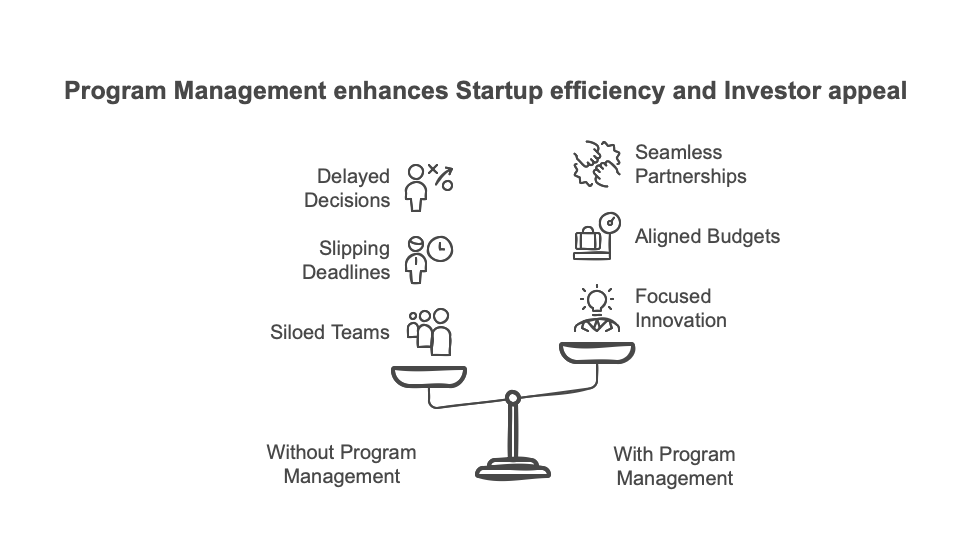
❌ Without Early Program Management
- Science teams become siloed
- Deadlines slip due to untracked dependencies
- Critical decisions delayed or made with incomplete information
- Investors perceive higher risk and lower operational readiness
✅ With Early Program Management
- Founders stay focused on science while PM handles orchestration
- Budgets aligned with realistic, risk-adjusted timelines
- External partners (CROs, academics) managed seamlessly
- Programs stay "pitch-ready" for BD and investor diligence
Whether You Hire or Consult: Start Early
Embedding program management doesn't always mean hiring a full-time PM on day one. Firms like BioVertex Consulting provide fractional or project-based support to help companies set up the right structure without sacrificing agility.
So if you're building an early-stage company or advising one, ask not "Can we afford program management now?" but rather "Can we afford not to?"
The Hidden Cost of Delayed Program Management
One of the most persistent misconceptions in early-stage biotech is that program management is a cost center that can be deferred until the team grows or funding increases. In reality, the cost of fixing problems caught late in drug development far exceeds the cost of PM support introduced early. When cross-functional coordination is absent, issues compound quietly beneath the surface. A gap in regulatory strategy, an untracked CMC dependency, or a miscommunication with a CDMO partner does not stay small for long. By the time it surfaces as a formal problem, the team is often weeks or months behind where it needs to be.
IND delays, failed audits, misaligned CMC and clinical timelines, and regulatory surprises are not random events. They are almost always symptoms of missing PM infrastructure earlier in the program. In drug development, a 6-month delay can cost millions of dollars in extended burn, lost partnership opportunities, and deferred revenue milestones. The cost of prevention, by contrast, is a fraction of the cost of remediation. Investing in structured program management at the preclinical stage is not a luxury; it is one of the highest-return decisions a founding team can make.
When Is the Right Time to Bring in a Program Manager?
There is no single inflection point that signals the need for a program manager, but there are clear patterns that indicate the time has come. If any of the following apply to your organization, the window for introducing PM structure is now rather than later:
- You have more than one active workstream running in parallel, such as CMC development alongside nonclinical studies, or regulatory planning alongside clinical strategy.
- You are 12 to 18 months from an IND filing and do not yet have an integrated development timeline with clearly tracked milestones and dependencies.
- You are preparing for a Series A or seed round and need to demonstrate operational discipline and a credible development plan to investors.
- You are managing external vendors including CROs, CDMOs, or academic collaborators whose deliverables are on the critical path.
- Your founding team is spending more time on coordination, follow-up, and status tracking than on core scientific and strategic work.
What to Look for in a Biotech Program Manager
Not every project manager is equipped to operate in the complexity of early-stage drug development. The right program manager for a biotech startup brings a specific combination of scientific context, operational skill, and interpersonal range. When evaluating candidates or consulting partners, prioritize the following qualities:
- Cross-functional experience spanning CMC, nonclinical, regulatory, and clinical domains, so the PM can speak credibly to each workstream and identify cross-functional risks before they escalate.
- The ability to build and manage integrated Gantt timelines that reflect realistic assumptions, resource constraints, and interdependencies across the full development program.
- Comfort working at both the strategic and operational levels, contributing to leadership discussions on portfolio prioritization while also managing day-to-day execution with functional teams.
- Strong communication and stakeholder management skills, including the ability to surface difficult information clearly, facilitate alignment across differing perspectives, and keep leadership informed without creating noise.
- Prior experience at biotech or pharma companies, not just general project management backgrounds, so the PM understands the regulatory environment, the language of drug development, and the stakes involved.
- Adaptability to the pace and ambiguity of early-stage environments, where priorities shift, data creates new questions, and the path forward is rarely fully defined in advance.
Getting Started Without Overcomplicating It
Early-stage program management does not need to be complex or burdensome to be effective. Many teams overthink the infrastructure required and delay getting started as a result. In practice, a strong foundation can be built from three simple elements: a clear program timeline that maps key milestones and dependencies across all workstreams, a decision log that captures key choices made and the rationale behind them, and a standing cross-functional meeting rhythm that keeps the right people aligned on the right cadence. These three tools alone can dramatically reduce coordination overhead and keep programs on track through the uncertainty of early development.
The goal of program management in an early-stage company is not to introduce bureaucracy. It is to create clarity. Clear owners. Clear milestones. Clear dependencies. When everyone on the team knows what is happening, why it is happening, and what depends on what, execution accelerates. Decisions get made faster, risks get surfaced earlier, and the organization moves with far greater confidence toward its next major milestone.
📣 Want to explore how embedding program management can accelerate your mission?